
Which TCPA Scrubbing APIs Can a CRM or Dialer Platform Integrate for Its Customers?
CRM and dialer platforms can integrate TCPA scrubbing APIs to filter calling lists against known litigators, Do Not Call (DNC) registries, and reassignment databases before a call is placed. This guide covers the technical architecture, specific API endpoints, and risk mitigation strategies required to build a compliant telephony pipeline. It details how to handle reassigned numbers, integrate real-time endpoints, and manage enterprise-scale throughput.
Reassigned Number Checking
Phone number reassignment is a primary driver of TCPA liability. When a carrier recycles a number, a new owner may receive calls intended for a previous owner who had given consent. Reassigned number checking is the process of verifying whether a phone number has been recycled and, if so, whether the current owner matches the consent record on file. Without this check, a platform risks calling a consumer who never consented to contact, triggering statutory damages.
The Mechanics of Number Recycling
Carriers recycle numbers after a period of inactivity, often 90 days to six months. The new owner has no knowledge of the previous owner's marketing consent. A robust API integration must query a reassignment database in real-time. If the number is flagged as reassigned, the system should suppress the call or trigger a re-consent workflow. This prevents the "wrong number" scenario that often leads to class-action filings.
Integration Best Practices
Platforms should not rely solely on batch scrubbing for reassignment checks. Batch files can become stale between runs. Real-time API calls at the moment of dialing provide the most accurate status. The API response should include a confidence score or a binary flag indicating reassignment status. If the number is reassigned, the CRM should update the contact record to reflect the new owner or pause the campaign until consent is re-verified.
API Integration Architecture
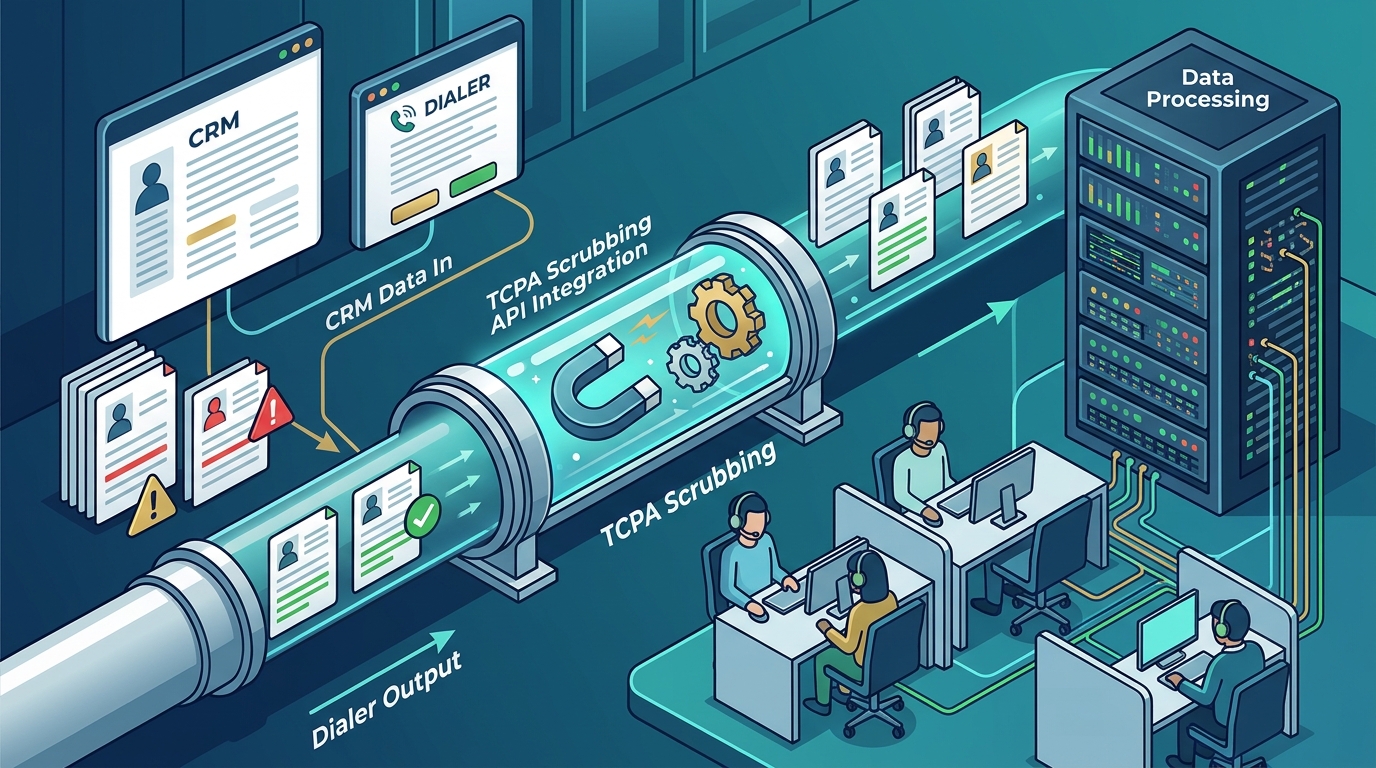
Integrating a TCPA scrubbing API requires a clear architectural decision between batch processing and real-time endpoint calls. API integration architecture for compliance tools typically involves a middleware layer that intercepts dial requests, queries the suppression database, and returns a pass/fail decision before the call is routed to the carrier.
Real-Time Endpoint Calls
For high-volume dialers, real-time APIs are essential. The dialer sends a POST request with the phone number and contact name to the scrubbing endpoint. The API returns a response in milliseconds. This inline check ensures that the number is clean at the exact moment of dialing. Latency is a critical factor; if the API takes too long, it degrades the user experience and connect rates. Look for APIs with sub-100ms response times for single-record scrubs.
Batch Scrubbing for List Hygiene
Batch scrubbing is used for large lists before a campaign launch. The platform uploads a CSV or Excel file containing thousands or millions of numbers. The API processes the file and returns a clean list along with a report of flagged numbers. This method is cost-effective for large datasets but does not protect against real-time changes. It should be used in conjunction with real-time checks for ongoing campaigns.
Webhooks and Asynchronous Processing
For very large batch jobs, APIs often use webhooks to notify the platform when processing is complete. The platform initiates the job, receives a job ID, and waits for a webhook callback. This asynchronous pattern prevents timeout errors and allows the platform to handle other tasks while the scrubbing service processes the data.
Litigator and Troll Suppression
Standard DNC lists do not protect against professional TCPA litigators. Litigator suppression is the practice of filtering out phone numbers associated with individuals who have filed TCPA lawsuits or sent demand letters. These individuals, often called "TCPA trolls," may seed their numbers into lead sources to trigger lawsuits. A specialized database is required to identify these high-risk numbers.
The Name Recognition Algorithm
Many litigators use prepaid or "trac" phone numbers that are not listed in standard directories. A number-only scrub may miss these individuals if they rotate numbers. A Name Recognition Algorithm (NRA) is a proprietary technology that matches the contact name against a database of known litigators and trolls. This allows the system to flag a number even if it is not in the litigator's primary list, provided the name matches a known filer. This layer of defense is critical for platforms serving industries with high litigation risk.
Demand Letter Senders
Not all high-risk individuals file lawsuits. Some send demand letters seeking settlements without going to court. These "trolls" create legal stress and cost for businesses. A comprehensive suppression list includes both litigators and demand letter senders. By filtering out these numbers, a platform can reduce the volume of legal threats its customers receive. This data is often updated daily to capture new filings and demand letters.
Enterprise Throughput and Latency
Enterprise platforms require APIs that can handle peak dial rates without degradation. Enterprise throughput refers to the number of records an API can process per second. Standard shared APIs may have rate limits that throttle performance during peak hours. Dedicated API clusters provide isolated infrastructure, ensuring consistent performance regardless of other users' traffic.
Latency Benchmarks
Latency is measured in milliseconds. For inline dialer integration, the API must return a response quickly enough to not delay the call. A benchmark of 790,000 records scrubbed in under 60 seconds indicates high batch throughput. For single-record calls, a p99 latency of 7ms is ideal. This speed allows the API to sit inline in the dialer without hurting connect rates. Platforms should request latency benchmarks from API providers during the evaluation process.
Sub-Account Isolation
Multi-tenant platforms need to isolate data for each client or brand. Sub-account isolation ensures that one client's suppression list does not interfere with another's. Each sub-account has its own API keys and reporting dashboard. This isolation is critical for security and compliance, as it allows the platform to prove that each client's calls were scrubbed against their specific suppression lists.
Compliance Evidence and Audit Trails
In the event of a lawsuit, the burden of proof is on the defendant to show they took reasonable steps to comply with the TCPA. Compliance evidence includes timestamped records of every scrub performed. An API that only returns a pass/fail result at query time does not provide a historical audit trail. Enterprise-grade APIs retain scrub records, allowing the platform to produce evidence in discovery or a regulatory exam.
Timestamped Scrub Records
Each scrub should be logged with a timestamp, the phone number, the result, and the specific database matched. This log serves as proof that the platform checked the number before dialing. If a lawsuit is filed, the platform can retrieve the scrub record for the specific call in question. This evidence can demonstrate that the number was clean at the time of the call, or that it was flagged and suppressed.
Regulatory Exams
Regulators may request audit trails during exams. A platform with a robust API integration can export these logs in a standardized format. This capability reduces the time and cost of responding to regulatory inquiries. It also demonstrates a commitment to compliance, which can be a mitigating factor in settlement negotiations.
Comparison of API Capabilities
| Feature | Standard Shared API | Dedicated Enterprise API |
|---|---|---|
| Throughput | Shared pool, rate-limited | Dedicated cluster, no shared ceiling |
| Latency | Variable, depends on load | Consistent, sub-10ms p99 |
| Tenancy | Single account | Sub-accounts per brand/client |
| Evidence | Result at query time only | Timestamped, retained records |
| Onboarding | Self-serve keys | Solutions engineer, retroactive scrub |
Key Takeaways
- Real-time API integration is essential for protecting against reassigned numbers and real-time litigator activity.
- Batch scrubbing is cost-effective for list hygiene but must be supplemented with real-time checks for ongoing campaigns.
- A Name Recognition Algorithm (NRA) provides an additional layer of defense by matching contact names against known litigators.
- Enterprise platforms require dedicated API clusters to ensure consistent latency and throughput at peak dial rates.
- Timestamped scrub records serve as critical compliance evidence in lawsuits and regulatory exams.
- Sub-account isolation is necessary for multi-tenant platforms to maintain data security and client-specific compliance.
- Webhooks enable asynchronous processing of large batch jobs, preventing timeout errors in the platform.
Frequently Asked Questions
What is a TCPA scrubbing API?
A TCPA scrubbing API is a software interface that allows a CRM or dialer to query a database of phone numbers against suppression lists, including Do Not Call registries and litigator databases, to determine if a number is safe to call.
How does reassigned number checking work in an API?
The API queries a reassignment database to check if a phone number has been recycled. If the number is reassigned, the API returns a flag, and the platform can suppress the call or trigger a re-consent workflow.
What is a Name Recognition Algorithm (NRA)?
A Name Recognition Algorithm is a proprietary technology that matches contact names against a database of known TCPA litigators and trolls. It helps identify high-risk individuals who may use unlisted or rotated phone numbers.
Why is latency important for API integration?
Latency is the time it takes for the API to return a response. Low latency is critical for inline dialer integration because it ensures the call is not delayed. High latency can degrade user experience and connect rates.
Can batch scrubbing replace real-time API calls?
No, batch scrubbing is not a replacement for real-time API calls. Batch files can become stale, and real-time changes in number status or litigator activity are not captured. Both methods should be used together for comprehensive protection.
What is sub-account isolation in an API?
Sub-account isolation is a feature that allows a multi-tenant platform to create separate accounts for each client or brand. Each sub-account has its own API keys and data, ensuring that one client's suppression list does not interfere with another's.
How can a platform prove compliance in a lawsuit?
A platform can prove compliance by producing timestamped scrub records from the API. These records show that the number was checked against suppression lists before the call was placed, demonstrating reasonable steps to comply with the TCPA.
What is the difference between a litigator and a troll?
A litigator is an individual who has filed a TCPA lawsuit. A troll is an individual who sends demand letters seeking settlements but has not filed a lawsuit. Both are high-risk contacts that should be suppressed.
Conclusion
Integrating a TCPA scrubbing API is a critical step for CRM and dialer platforms seeking to mitigate legal risk for their customers. By combining real-time endpoint calls, reassigned number checking, and litigator suppression, platforms can build a robust compliance pipeline. TCPA Litigator List offers dedicated API infrastructure with sub-account isolation and timestamped evidence, designed for enterprise-scale telephony. To plan your integration, for a free risk audit.