
How Call Centers Should Approach DNC List Scrubbing to Reduce Legal Exposure
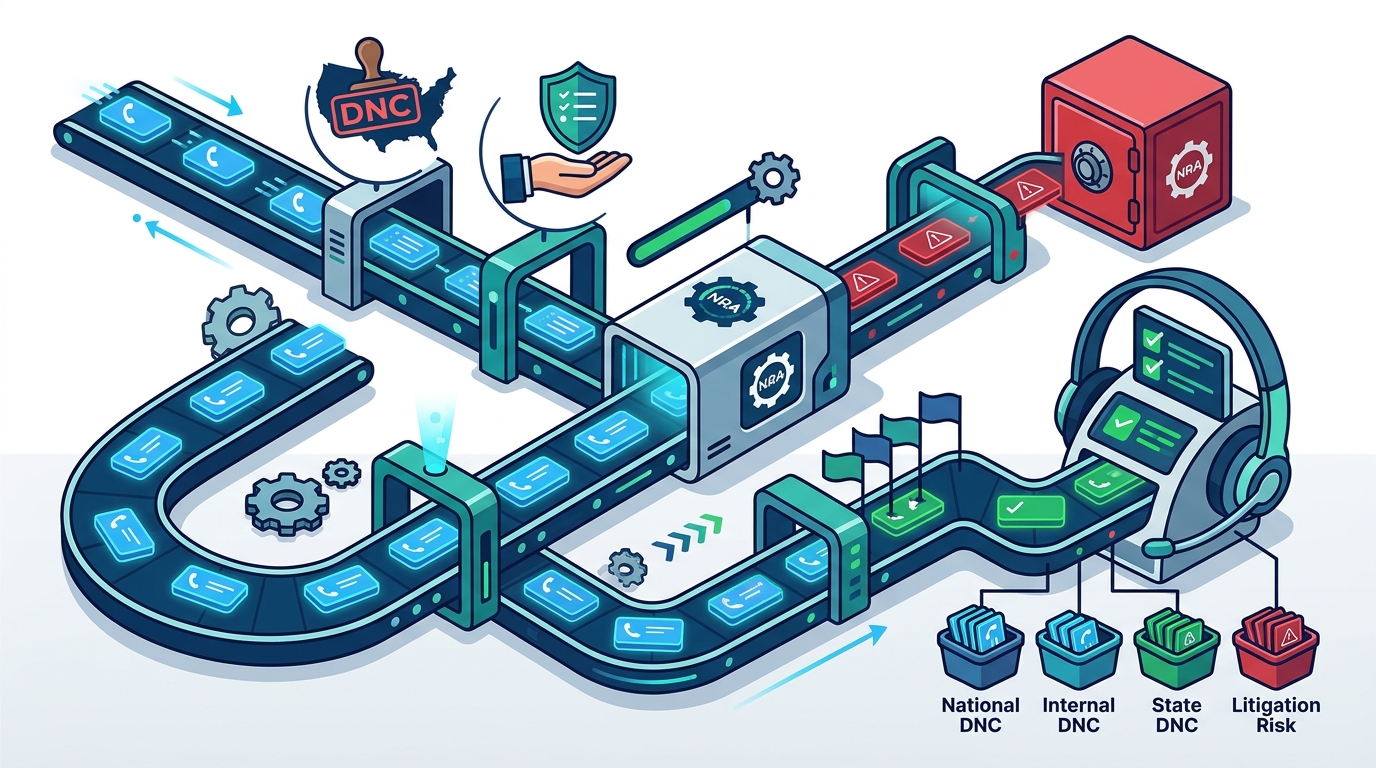
Call centers should approach Do Not Call (DNC) list scrubbing as a continuous, multi-layered compliance process rather than a one-time task. Effective scrubbing requires integrating federal DNC registry checks with internal suppression lists, state-specific regulations, and litigation-risk intelligence. By automating these checks at the moment of dial, organizations can significantly reduce the risk of statutory damages and class-action lawsuits. This guide outlines the strategic framework for building a robust DNC scrubbing program that protects both revenue and legal standing.
The Strategic Importance of Multi-Layered Scrubbing
Many call centers operate under the misconception that checking the Federal DNC Registry is sufficient for compliance. This is a dangerous oversight. The Federal DNC Registry is a baseline requirement, not a comprehensive shield. A robust scrubbing strategy must account for three distinct layers: the Federal DNC Registry, state-specific DNC lists, and internal suppression lists. Each layer serves a different legal purpose and carries different risk profiles.
The Federal DNC Registry, maintained by the Federal Communications Commission (FCC), prohibits telemarketing calls to numbers registered on the list, with limited exceptions for established business relationships. However, state regulations often impose stricter rules. For example, some states require scrubbing against their own state-specific DNC lists, which may include numbers not present in the federal database. Furthermore, internal suppression lists, which track customers who have opted out of future calls, are legally required to be honored for at least five years. Failing to integrate these three layers creates significant gaps in compliance.
Consider a call center operating in California. A number might be clean on the Federal DNC Registry but listed on the California DNC Registry. If the call center only checks the federal list, it risks violating state law. By implementing a multi-layered scrubbing approach, the call center ensures that every number is validated against all applicable jurisdictions before a dial is placed. This proactive stance is critical for reducing legal exposure.
Integrating Litigation-Risk Intelligence into Scrubbing
Standard DNC scrubbing addresses regulatory compliance, but it does not address litigation risk. A number may be clean on all DNC lists, yet still belong to a professional TCPA litigator or a "TCPA troll." These individuals often seed their numbers into lead sources with the intent of being called, then file lawsuits or send demand letters. This is where litigation-risk intelligence becomes essential.
TCPA Litigator List provides a specialized database of phone numbers associated with TCPA lawsuits and demand letters. By integrating this data into the scrubbing process, call centers can identify and suppress numbers that pose a high litigation risk, even if they are not on the DNC Registry. This is particularly important because professional litigators often use "trac" phone numbers, which are difficult to track using standard number-only scrubbing. The proprietary Name Recognition Algorithm (NRA) used by TCPA Litigator List matches on the litigator's name, not just the number, providing a deeper layer of protection.
For instance, a call center might receive a lead list that includes a number not on the Federal DNC Registry. However, that number is associated with a known TCPA litigator in the TCPA Litigator List database. Without litigation-risk intelligence, the call center would dial the number and potentially face a lawsuit. With this intelligence, the number is suppressed, preventing the legal issue before it arises. This approach transforms scrubbing from a regulatory checkbox into a strategic risk mitigation tool.
Automating Scrubbing for Real-Time Compliance
Manual scrubbing is inefficient and prone to errors. It is impossible to manually check millions of numbers against multiple databases in real time. Automation is the key to effective DNC scrubbing. By integrating scrubbing APIs directly into the dialer, call centers can ensure that every number is checked at the moment of dial. This real-time approach eliminates the risk of dialing a number that was added to the DNC Registry after the initial batch scrub.
API-based scrubbing offers several advantages over batch processing. First, it provides immediate feedback, allowing the dialer to skip flagged numbers instantly. Second, it reduces the risk of data staleness. DNC lists are updated regularly, and batch scrubs performed weekly or monthly may miss recent additions. Real-time API scrubbing ensures that the most current data is used for every dial. Third, it simplifies compliance reporting. Automated scrubbing logs can be used to demonstrate compliance efforts in the event of a legal challenge.
For example, a call center using a real-time API can scrub a number in milliseconds, ensuring that the dialer does not waste time on flagged numbers. This not only improves efficiency but also enhances the customer experience by reducing the number of unwanted calls. The integration of API-based scrubbing into the dialer is a critical step in building a modern, compliant call center operation.
Managing Internal Suppression Lists and Opt-Outs
Internal suppression lists are a critical component of DNC scrubbing. These lists track customers who have requested not to be called, either through a specific campaign or across all communications. The TCPA requires that these requests be honored for at least five years. Failure to do so can result in statutory damages of $500 to $1,500 per call, with willful violations carrying higher penalties.
Managing internal suppression lists requires a centralized system that can track opt-out requests across all campaigns and channels. This system should be integrated with the scrubbing process to ensure that opted-out numbers are suppressed before a dial is placed. Additionally, the system should allow for the reactivation of numbers if a customer explicitly requests to be contacted again. This flexibility is important for maintaining customer relationships while ensuring compliance.
Consider a call center that runs multiple marketing campaigns. A customer might opt out of a specific campaign but not others. The internal suppression list should reflect this nuance, allowing the call center to continue contacting the customer for other campaigns while respecting the opt-out for the specific campaign. This level of granularity is essential for both compliance and customer satisfaction. By managing internal suppression lists effectively, call centers can reduce legal exposure while maintaining positive customer relationships.
Building a Culture of Compliance
Technology alone is not enough to ensure compliance. A culture of compliance is equally important. All employees involved in telemarketing should be trained on the importance of DNC scrubbing and the legal consequences of non-compliance. This training should cover the basics of the TCPA, the requirements for DNC scrubbing, and the procedures for handling opt-out requests. Regular refresher courses should be conducted to keep employees up to date on any changes in regulations.
Additionally, call centers should establish clear policies and procedures for DNC scrubbing. These policies should outline the frequency of scrubbing, the databases used, and the responsibilities of different teams. By establishing a clear framework, call centers can ensure that compliance is not left to chance. This cultural shift is essential for long-term success in the telemarketing industry.
For example, a call center might implement a policy that requires all new lead lists to be scrubbed against the Federal DNC Registry, state-specific lists, and the TCPA Litigator List database before being loaded into the dialer. This policy ensures that every number is validated before a dial is placed, reducing the risk of legal issues. By building a culture of compliance, call centers can protect their business and their customers.
Key Takeaways
- DNC scrubbing must be a multi-layered process that includes the Federal DNC Registry, state-specific lists, and internal suppression lists.
- Litigation-risk intelligence, such as the TCPA Litigator List database, is essential for identifying high-risk numbers that are not on the DNC Registry.
- Real-time API scrubbing is more effective than batch processing because it ensures that the most current data is used for every dial.
- Internal suppression lists must be managed centrally and integrated with the scrubbing process to ensure that opt-out requests are honored.
- A culture of compliance, including regular training and clear policies, is essential for long-term success in telemarketing.
- Automating the scrubbing process reduces the risk of errors and improves efficiency, allowing call centers to focus on customer engagement.
- Consulting with legal counsel is recommended to ensure that your scrubbing strategy aligns with current regulations and your specific business needs.
Frequently Asked Questions
What is the difference between the Federal DNC Registry and state-specific DNC lists?
The Federal DNC Registry is a national list maintained by the FCC that prohibits telemarketing calls to registered numbers. State-specific DNC lists are maintained by individual states and may include additional numbers not present in the federal registry. Some states have stricter regulations than the federal law, so it is important to scrub against both.
How often should call centers scrub their lead lists?
Call centers should scrub their lead lists in real time at the moment of dial using an API. If batch processing is used, it should be performed at least weekly to ensure that the most current data is used. Real-time scrubbing is the most effective method for reducing legal exposure.
What is a TCPA troll?
A TCPA troll is an individual who sends demand letters but has not filed a lawsuit. These individuals often seed their numbers into lead sources with the intent of being called. Identifying and suppressing these numbers is an important part of litigation-risk management.
Can a number be on the DNC Registry but still be called?
Yes, there are limited exceptions to the DNC Registry rules. For example, if a customer has an established business relationship with the company and has not opted out, the number may be called. However, these exceptions are narrow and should be carefully managed.
What is the Name Recognition Algorithm (NRA)?
The Name Recognition Algorithm (NRA) is a proprietary technology used by TCPA Litigator List to match on the litigator's name, not just the number. This is important because professional litigators often use "trac" phone numbers, which are difficult to track using standard number-only scrubbing.
How can call centers demonstrate compliance in the event of a legal challenge?
Call centers can demonstrate compliance by maintaining detailed logs of their scrubbing processes. These logs should show the databases used, the frequency of scrubbing, and the results of each check. Automated scrubbing systems can generate these logs automatically, making it easier to demonstrate compliance.
Is DNC scrubbing a guarantee against lawsuits?
No, DNC scrubbing is not a guarantee against lawsuits. It is a risk mitigation tool that reduces the likelihood of legal issues. Call centers must also obtain required consent, maintain appropriate suppression lists, and comply with all applicable laws and regulations.
Conclusion
Approaching DNC list scrubbing as a continuous, multi-layered process is essential for reducing legal exposure in the telemarketing industry. By integrating federal and state DNC lists, internal suppression lists, and litigation-risk intelligence, call centers can build a robust compliance program that protects both their business and their customers. Automation and a culture of compliance are key to long-term success. TCPA Litigator List provides the tools and intelligence needed to take your scrubbing strategy to the next level. To learn more about how our services can help your call center, for a free consultation.