

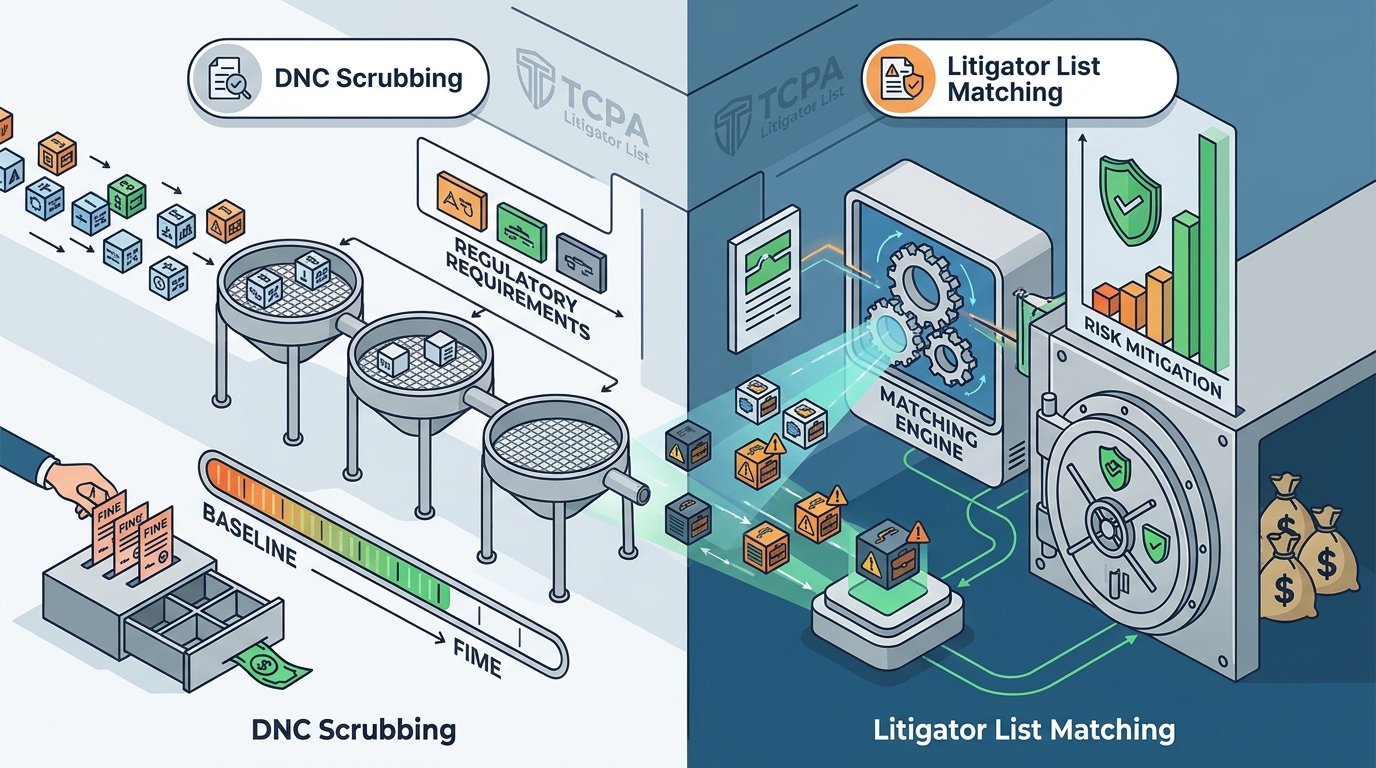
Standard DNC scrubbing prevents regulatory fines, while litigator list matching prevents class action lawsuits. For call centers, the difference is the difference between a fine and a multi-million dollar settlement. Standard scrubbing is a baseline requirement. Litigator matching is an advanced risk mitigation tool. TCPA Litigator List provides the specialized data needed to identify serial filers before they dial your number.
Standard DNC Scrubbing
Standard DNC scrubbing is the process of removing phone numbers from a calling list that are registered on the National Do Not Call Registry. This is a federal requirement under the Telephone Consumer Protection Act (TCPA). The Federal Trade Commission (FTC) and the Federal Communications Commission (FCC) enforce these rules. If you call a number on the National DNC Registry, you face statutory penalties. These penalties can range from $500 to $1,500 per violation. Willful violations can cost up to $4,500 per call. This is a compliance floor, not a ceiling.
Most call centers use standard scrubbing as their first line of defense. It is cheap and easy to implement. However, it has a critical blind spot. The National DNC Registry only contains numbers that consumers have voluntarily registered. It does not contain numbers of people who have sued you before. It does not contain numbers of professional TCPA litigators. It does not contain numbers of individuals who send demand letters. If a serial filer has not registered their number with the FTC, standard scrubbing will miss them entirely. This is where the risk lies.
Strengths of Standard Scrubbing
- Legally required for all telemarketers.
- Low cost and easy to integrate.
- Prevents FTC fines and regulatory action.
- Widely available from many providers.
Limits of Standard Scrubbing
- Does not identify professional litigators.
- Does not identify demand letter senders.
- Does not account for state-specific DNC lists.
- Does not protect against class action lawsuits.
Standard scrubbing is essential, but it is not sufficient for high-volume call centers. It protects you from regulators, not from plaintiffs.
Litigator List Matching
Litigator list matching is a specialized screening process that identifies phone numbers associated with professional TCPA litigators and serial demand letter senders. This is not a regulatory requirement. It is a risk management strategy. TCPA Litigator List maintains a database of over 340,000 litigator numbers and 260 million troll and DNC records. This database is updated daily as new lawsuits are filed. The goal is to prevent your dialer from reaching a number that is likely to result in a lawsuit.
Professional TCPA litigators often seed their numbers into lead lists. They wait for a call center to dial their number. Once they receive a call, they file a lawsuit. This is a business model for them. Litigator list matching identifies these numbers before you dial them. It uses a proprietary Name Recognition Algorithm (NRA) to match names, not just numbers. This is critical because litigators often rotate phone numbers. If you only match numbers, you will miss them when they switch lines. If you match names, you catch them.
Strengths of Litigator Matching
- Identifies professional TCPA litigators.
- Identifies serial demand letter senders (trolls).
- Uses name recognition to catch number rotation.
- Prevents class action lawsuits.
- Updated daily with new case data.
Limits of Litigator Matching
- Not a regulatory requirement.
- Higher cost than standard scrubbing.
- Requires integration with dialer or database.
- Does not replace standard DNC scrubbing.
Litigator list matching is an advanced tool for businesses that face high litigation risk. It is not a replacement for standard scrubbing. It is a complement to it.
Comparison Table
| Criteria | Standard DNC Scrubbing | Litigator List Matching |
|---|---|---|
| Primary Goal | Regulatory Compliance | Litigation Risk Mitigation |
| Data Source | National DNC Registry | Court Filings and Demand Letters |
| Identifies Litigators | No | Yes |
| Identifies Trolls | No | Yes |
| Legal Requirement | Yes | No |
| Cost | Low | Higher |
Choose Standard Scrubbing If
Choose standard DNC scrubbing if you are a small business with low call volume. If you make fewer than 1,000 calls per month, the risk of a class action lawsuit is low. Standard scrubbing will protect you from FTC fines. It is the minimum viable compliance program. If you are just starting out, this is where you should begin. However, as your volume grows, you will need to add litigator matching.
Choose Litigator Matching If
Choose litigator list matching if you are a high-volume call center. If you make more than 10,000 calls per day, you are a target for professional litigators. The cost of a single class action lawsuit can exceed the cost of litigator matching for a year. If you have been sued before, you are a target. If you operate in high-risk states like California, Florida, or Illinois, you are a target. Litigator matching is an investment in risk prevention. It is not an expense. It is a shield.
Frequently Asked Questions
Can I use litigator matching instead of standard DNC scrubbing?
No. Litigator matching is not a replacement for standard DNC scrubbing. You must still scrub against the National DNC Registry to comply with federal law. Litigator matching is an additional layer of protection. It identifies risks that standard scrubbing misses. You need both for a complete compliance program.
How often is the litigator list updated?
Our database is updated daily. New TCPA cases are filed every day. Our research team investigates every new case and adds the associated phone numbers and names to the database. This ensures that your scrubbing is always current. Yesterday's list is already stale. Daily updates are critical for effective risk mitigation.
What is a TCPA troll?
A TCPA troll is an individual who sends demand letters but has never filed a lawsuit. They use the threat of litigation to extract settlements. They are not professional litigators, but they are a significant risk. Our database includes over 260 million troll and DNC records. Identifying these individuals can save you from unnecessary legal stress and settlement costs.
Does litigator matching guarantee I won't be sued?
No. No screening service can guarantee that you will not be sued. Litigator matching reduces your risk by identifying known high-risk numbers. It does not eliminate all risk. You must still maintain proper consent records, honor opt-out requests, and comply with all applicable laws. Screening results are informational and do not constitute legal advice.
How do I integrate litigator matching with my dialer?
Our API allows you to integrate litigator matching directly into your dialer or database. The API returns results in single-digit milliseconds, so it does not slow down your dialing. You can scrub in real-time as each call is dialed. This ensures that you never dial a high-risk number. Integration is straightforward and can be completed in a few days.
What is the cost of litigator matching?
Costs vary based on volume and plan. Our packages range from basic scrubbing to enterprise-level API access. You can purchase scrub coins for additional volume. For specific pricing, please contact our team for a custom quote. The cost of litigator matching is a fraction of the cost of a single class action lawsuit.
Conclusion
Standard DNC scrubbing and litigator list matching serve different purposes. Standard scrubbing protects you from regulators. Litigator matching protects you from plaintiffs. For high-volume call centers, both are essential. TCPA Litigator List provides the data and technology you need to mitigate litigation risk. Our proprietary Name Recognition Algorithm and daily updates ensure that you are always protected. Do not wait for a lawsuit to realize you need better protection. to learn more about our services and how we can help you call with confidence.