
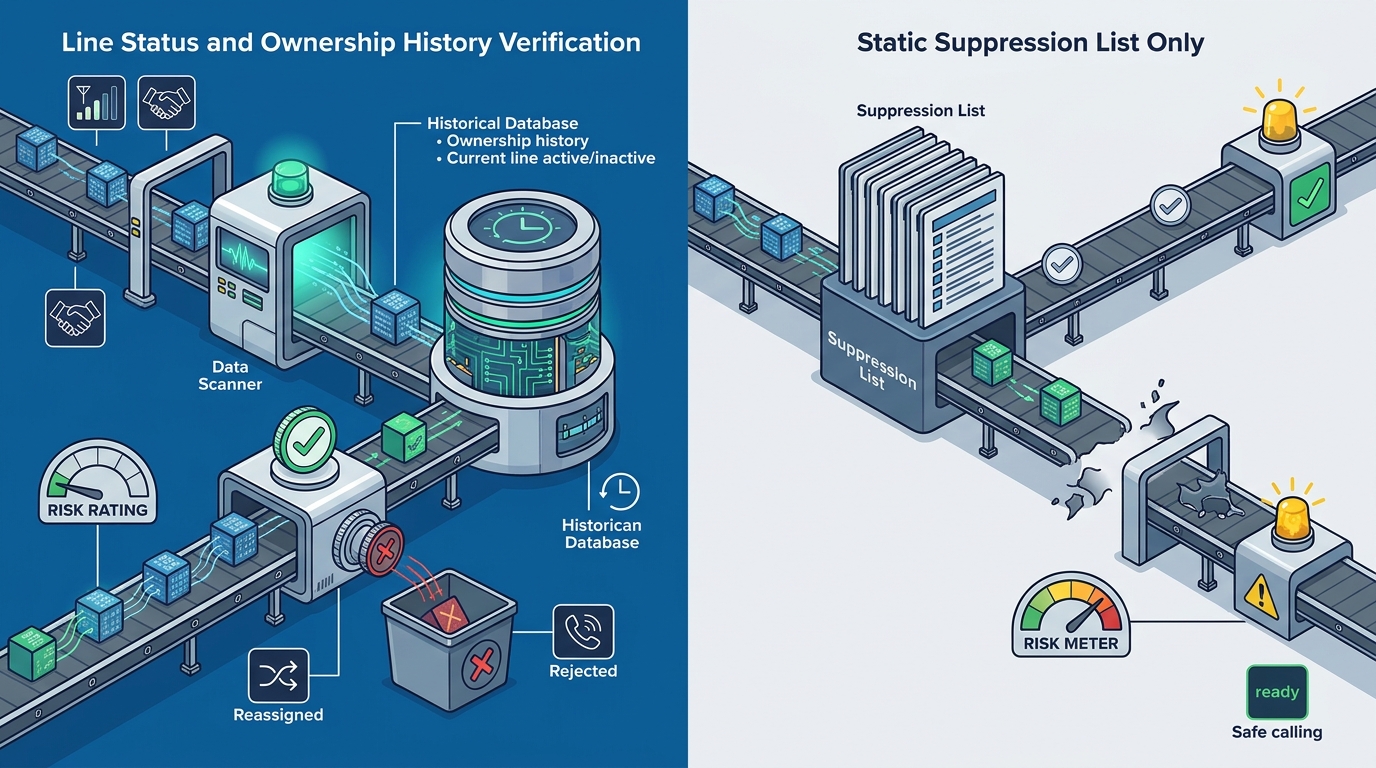
Reassigned number checking is a critical differentiator in TCPA compliance. APIs that verify line status and ownership history protect against calling former consent holders, while those that only check static suppression lists leave a significant gap in risk mitigation. For businesses using predictive dialers, the choice between these two technical approaches directly impacts statutory damage exposure. This comparison clarifies which solution fits your specific operational risk profile.
TCPA Litigator List: Litigation Risk Intelligence
TCPA Litigator List focuses on identifying high-risk individuals rather than just line status. The platform utilizes a proprietary Name Recognition Algorithm (NRA) to match phone numbers against a database of known TCPA litigators and demand letter senders. This approach addresses the specific threat of professional plaintiffs who may have previously consented to calls but are now actively seeking litigation. By scrubbing against this registry, businesses can identify numbers associated with prior lawsuits or aggressive demand letters, which is a distinct risk vector from simple reassignment.
The service is best suited for organizations that have experienced demand letters or are targeting markets with high litigation density. It provides a layer of intelligence that standard line-status checks do not offer, specifically flagging the *person* behind the number. However, it is important to note that this is a risk mitigation tool, not a substitute for consent management. It helps you avoid the most dangerous targets in your list, but it does not verify if the current holder of the number originally gave consent.
Line Status and Reassignment APIs
Line status APIs, often integrated into broader data hygiene platforms, focus on the technical attributes of the phone number itself. These services check the current carrier, line type (mobile vs. landline), and, crucially, the date the number was activated. If a number was activated after the date a consumer provided consent, the API flags it as reassigned. This is the primary technical defense against the "reassigned number" defense in TCPA litigation, where a plaintiff claims they never consented because they only recently acquired the number.
These APIs are essential for high-volume dialers that rely on historical consent data. They ensure that the consent on file matches the current holder of the line. The limitation is that they do not know if the current holder is a professional litigator. A number can be technically "clean" (not reassigned) but still belong to a serial filer. Therefore, line status checks are a foundational requirement for any TCPA-compliant dialing operation, but they are not a complete risk solution on their own.
Comparison of API Capabilities
| Criteria | TCPA Litigator List | Line Status / Reassignment APIs |
|---|---|---|
| Primary Function | Identifies known litigators and demand letter senders | Verifies current line ownership and activation date |
| Reassignment Check | Indirect (via name/number history) | Direct (via carrier activation data) |
| Consent Verification | No (Risk intelligence only) | Yes (Matches consent date to activation date) |
| Best For | High-risk markets, demand letter mitigation | High-volume dialing, consent hygiene |
| Integration | Real-time API, Batch Scrub | Real-time API, Batch Upload |
Choosing the Right Solution
Choose Line Status APIs if: Your primary risk is calling numbers that have changed hands since consent was collected. If you are running a large-scale predictive dialer with a database of historical opt-ins, you must verify that the current holder is the same person who consented. This is a baseline compliance requirement for most telemarketing operations.
Choose TCPA Litigator List if: You are receiving demand letters or operating in jurisdictions with high TCPA litigation activity. If your line status checks are clean but you are still being sued, the issue is likely not reassignment but rather targeting professional plaintiffs. The Name Recognition Algorithm helps you filter out these high-risk individuals before they enter your dialing queue.
Choose Both if: You want a comprehensive risk mitigation strategy. Using a line status API to ensure consent validity and a litigation risk API to filter out professional plaintiffs provides the strongest defense against statutory damages. Many enterprise compliance programs now utilize both layers to create a robust suppression workflow.
Frequently Asked Questions
Does a line status check guarantee TCPA compliance?
No. A line status check verifies that the number has not been reassigned since consent was given. It does not verify that the consent was valid, that the caller has the right to make the call, or that the number is not on the National Do Not Call Registry. It is one component of a broader compliance program.
Can I use TCPA Litigator List instead of a line status check?
It is not recommended to use them as substitutes. They solve different problems. Line status checks address the "reassigned number" defense, while TCPA Litigator List addresses the "professional plaintiff" risk. For maximum protection, businesses should use both.
How often should I re-check my list for reassignments?
Best practice is to check line status in real-time at the moment of dialing. If you are using batch processing, you should re-scrub your list at least monthly, as numbers can be reassigned at any time. Real-time APIs are preferred for predictive dialers to ensure the data is current at the instant of the call.
What is the difference between a "Troll" and a "Litigator" in this context?
A TCPA Troll is an individual who sends demand letters but has not filed a lawsuit. A TCPA Litigator is an individual who has filed a lawsuit. TCPA Litigator List tracks both, allowing businesses to suppress numbers associated with either group to prevent escalation from demand letters to formal litigation.
Is there a cost difference between these two types of APIs?
Yes. Line status checks are generally priced per record and are a standard feature of most data hygiene platforms. Litigation risk intelligence, such as the services provided by TCPA Litigator List, is often priced as a subscription or per-scrub fee due to the specialized nature of the data and the proprietary algorithms used to maintain the registry.
Conclusion
Understanding the distinction between reassigned number checks and litigation risk intelligence is vital for modern telemarketing compliance. Line status APIs protect your consent data integrity, while specialized services like TCPA Litigator List protect your business from professional plaintiffs. By integrating both, you create a multi-layered defense that addresses the full spectrum of TCPA risks. To see how these solutions can be integrated into your existing dialer or CRM, for a consultation.