

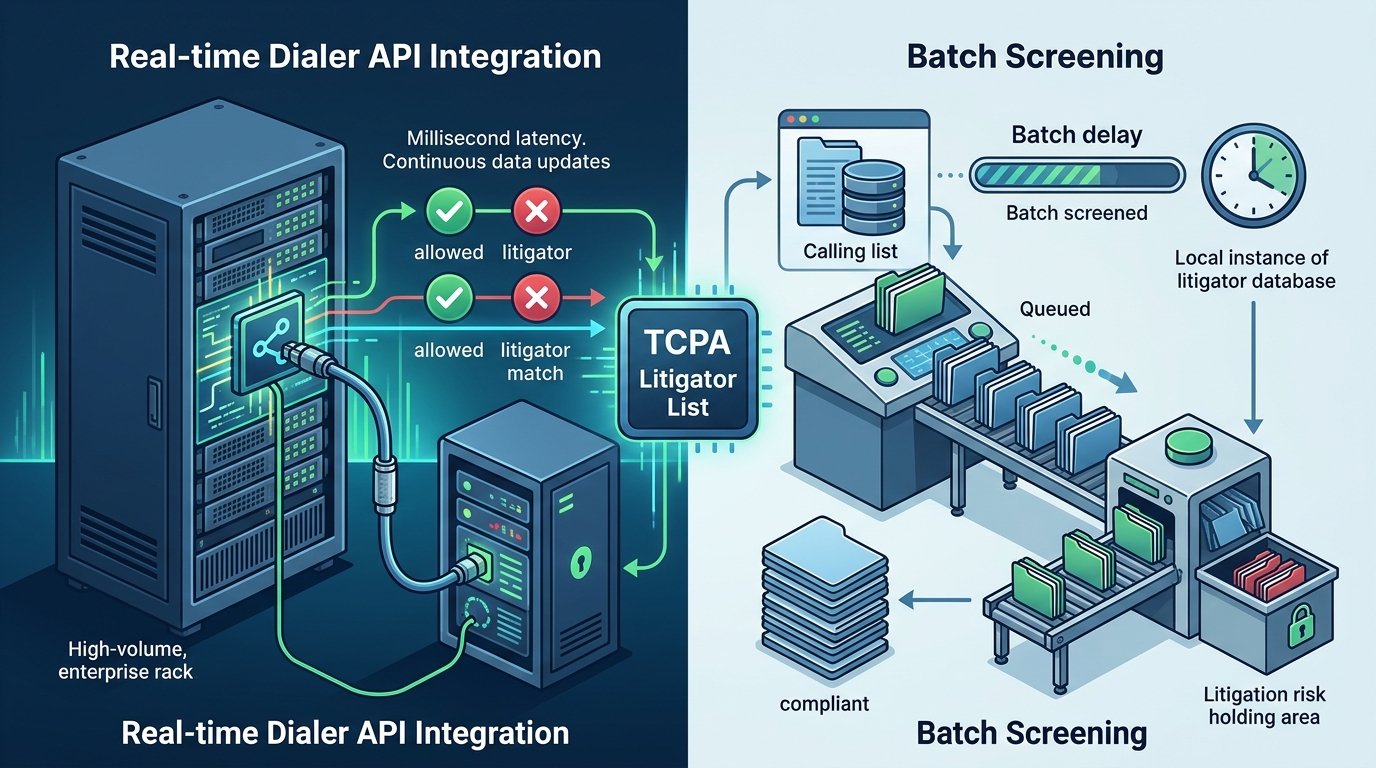
Real-time API integration is the superior method for high-volume dialers requiring immediate TCPA risk mitigation, while batch screening remains a viable, lower-cost option for low-frequency campaigns. API connections offer millisecond latency and continuous data updates, making them ideal for enterprise dialers. Batch screening suits smaller operations that can tolerate a delay between list preparation and dialing. TCPA Litigator List supports both workflows, allowing businesses to select the integration method that aligns with their operational cadence and risk tolerance.
Real-Time API Integration
Real-time API integration is a method where the dialer queries a compliance database for each number immediately before placing a call. This approach ensures that the screening data is as current as possible, reflecting the most recent litigation records and Do Not Call registrations. For businesses using predictive or power dialers, this inline check is critical because it prevents the dialer from consuming a number that has recently been flagged as a high-risk litigator.
Latency and Throughput
The primary technical requirement for real-time integration is low latency. A dialer must receive a response quickly enough to avoid delaying the call connection. TCPA Litigator List provides a dedicated API infrastructure designed for high throughput, capable of processing hundreds of thousands of records in seconds. This speed ensures that the compliance check does not become a bottleneck in the dialing workflow. The API returns a simple boolean or detailed status, allowing the dialer to suppress the number instantly if a match is found.
Continuous Data Freshness
Traditional lists become stale quickly as new lawsuits are filed and new numbers are added to suppression databases. An API connection pulls data from a live source, meaning the check reflects the current state of the registry. This is particularly important for the Name Recognition Algorithm, which matches individuals across different phone numbers. If a serial filer changes their number, a static list might miss them, but a real-time API query can flag the new number based on the associated name data.
Batch Screening and File Uploads
Batch screening is a process where a business uploads a large file of phone numbers to a compliance service for processing, then downloads the cleaned list for use in their dialer. This method is often referred to as file-based scrubbing. It is well-suited for businesses that prepare their calling lists in advance, such as those running scheduled campaigns or using manual dialing. The process involves uploading a CSV or Excel file, selecting the specific validation types (such as TCPA litigators or Federal DNC), and waiting for the results.
Cost and Simplicity
Batch screening is generally more cost-effective for low-volume operations because it does not require complex API development or real-time infrastructure. The user interface for batch uploads is straightforward, allowing non-technical staff to manage the screening process. For a small business that dials 1,000 numbers a week, the overhead of building an API integration may not be justified. The simplicity of the upload-and-download workflow makes it an accessible entry point for compliance.
Limitations of Static Data
The main drawback of batch screening is the time lag between the screening event and the actual dialing. If a number is screened on Monday and dialed on Friday, the data is four days old. During that window, the number could have been added to a suppression list or associated with a new lawsuit. While this risk is lower for low-volume dialers, it is a significant factor for high-volume operations where the volume of calls increases the probability of hitting a recently flagged number.
Comparison of Screening Methods
| Criteria | Real-Time API | Batch Screening |
|---|---|---|
| Data Freshness | Live, millisecond-level updates | Static, dependent on upload date |
| Implementation Complexity | Requires developer resources | Low, user-interface driven |
| Best For | High-volume, automated dialers | Low-volume, manual or scheduled dialing |
| Cost Structure | Per-call or volume-based | Per-file or subscription-based |
| Risk Mitigation | Immediate suppression at dial time | Pre-dial suppression, potential lag |
Choosing the Right Integration Method
Selecting the appropriate screening method depends on your dialing volume, technical resources, and risk appetite. The following guidance helps you determine which approach aligns with your operational needs.
Choose Real-Time API If
- You operate a predictive, power, or auto-dialer that places hundreds or thousands of calls per hour.
- You have in-house developers or a technical team capable of integrating RESTful APIs.
- You require timestamped evidence of screening for compliance audits or legal discovery.
- You want to leverage the Name Recognition Algorithm to catch serial filers who rotate numbers.
Choose Batch Screening If
- Your dialing volume is low, typically under 10,000 calls per month.
- You use manual dialing or a simple dialer that does not support API hooks.
- You prepare calling lists in batches and can tolerate a short delay between screening and dialing.
- You lack the technical resources to build and maintain an API integration.
Frequently Asked Questions
Can I switch from batch screening to API integration later?
Yes, most compliance platforms, including TCPA Litigator List, allow users to upgrade their service tier. You can start with batch screening to validate the data quality and then migrate to API integration as your volume grows. The underlying database is the same, so the transition is primarily a technical and billing change.
Does API integration guarantee TCPA compliance?
No, no screening service can guarantee full compliance. API integration reduces risk by filtering out known litigators and Do Not Call numbers, but you remain responsible for obtaining consent, honoring opt-outs, and adhering to all federal and state regulations. Screening is a risk mitigation tool, not a legal safe harbor.
What is the cost difference between API and batch screening?
Cost structures vary by provider. Batch screening is often priced per file or as a flat subscription, making it predictable for low volumes. API integration is typically priced per call or in volume tiers, which can be more cost-effective at high volumes but more expensive for low volumes. You should evaluate your monthly call volume to determine the most economical option.
How does the Name Recognition Algorithm work in API mode?
In API mode, the Name Recognition Algorithm checks the phone number against a database of known litigators and also matches the name associated with the number. If the name matches a known serial filer, the number is flagged even if the specific phone number is new. This provides an additional layer of protection that static number-only lists cannot offer.
Is batch screening sufficient for enterprise dialers?
Generally, no. Enterprise dialers with high call volumes face a higher statistical risk of hitting a recently flagged number if they rely on static lists. The time lag between screening and dialing increases the exposure. For enterprise operations, real-time API integration is the recommended standard to minimize this risk.
Conclusion
The choice between real-time API integration and batch screening depends on your dialing volume and technical capabilities. High-volume, automated dialers benefit from the immediacy and data freshness of API connections, while low-volume operations can effectively use batch screening. TCPA Litigator List provides robust tools for both methods, ensuring that your compliance program is tailored to your specific operational needs. To determine the best fit for your business, for a consultation.